
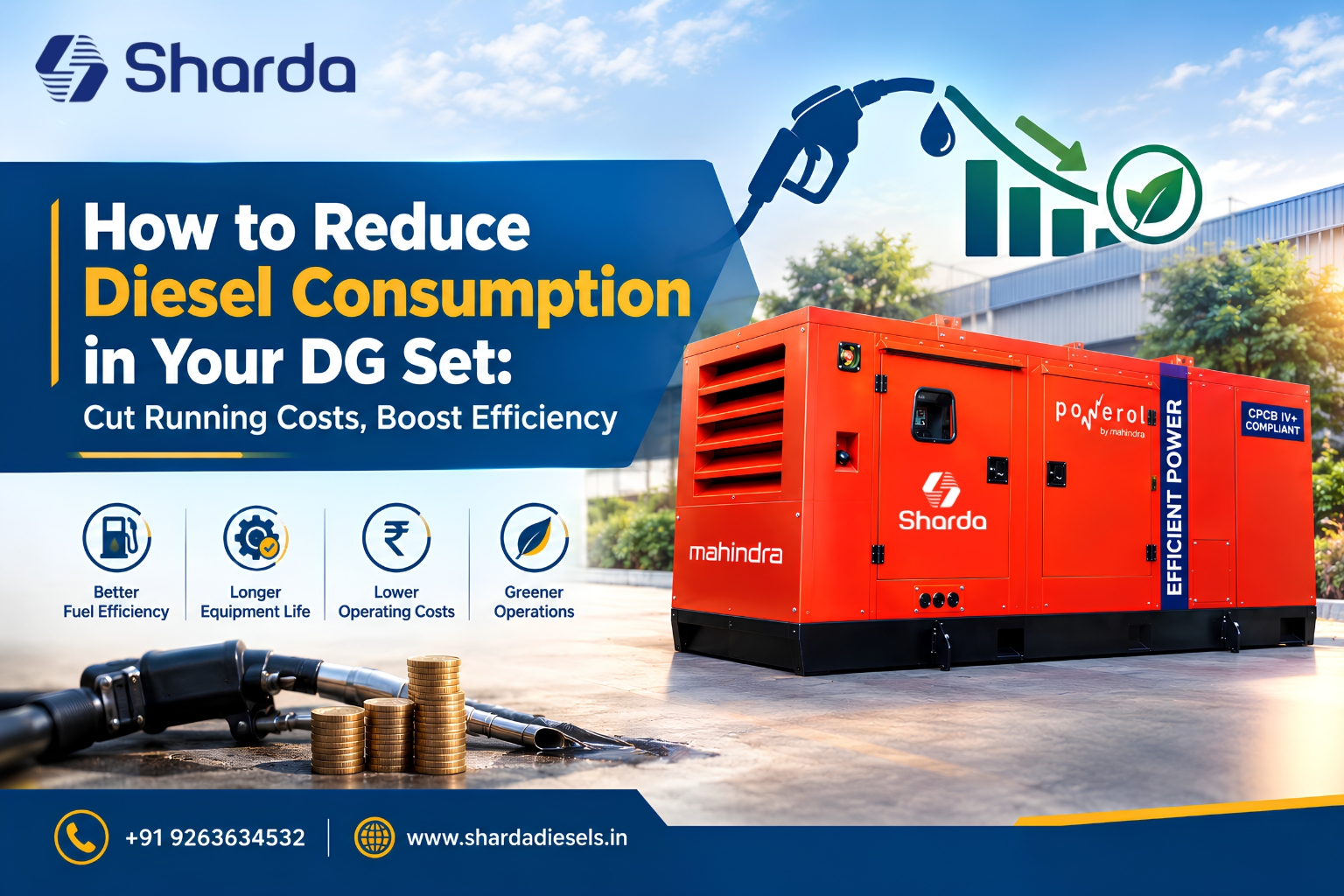
Fuel is the cost that never stops. Every hour your diesel generator runs, money is leaving your business — and for most commercial and industrial users, that number adds up to something significant very quickly.
Here is what the real math looks like. A 62.5 kVA diesel generator running at 75% load burns approximately 8 to 10 litres of diesel per hour. At current diesel prices of around ₹93 to ₹98 per litre in most of Jharkhand, Bihar, and Chhattisgarh, that is ₹750 to ₹980 every single hour of running time. Run your generator 6 hours a day for 250 days a year and you are looking at ₹11 to ₹15 lakh in fuel costs — every year, from just one generator.
For a 100 kVA generator at the same load, fuel consumption climbs to 15 to 18 litres per hour. The annual fuel bill gets bigger fast.
The good news is that a well-maintained, correctly operated diesel generator uses significantly less fuel than one that is poorly sized, poorly maintained, or run in ways that quietly destroy its efficiency. Here are 10 practical things you can do — some immediately, some as part of your maintenance plan — that will make a real, measurable difference to your DG set running cost.
1. Stop Running Your Generator at Low Load — It Is Costing You More Than You Think
This surprises most generator owners. Running a generator at low load — below 40% of its rated capacity — actually burns more fuel per unit of electricity produced than running it at 70 to 80% load.
At 75% load, a diesel generator burns roughly 0.26 litres per kWh. Drop that to 25% load, and the same engine burns 0.36 litres per kWh — nearly 40% more fuel for the same output. And the damage does not stop at fuel waste. Running at very low load below 30% causes what engineers call wet stacking — unburned fuel and carbon deposits build up in the exhaust system and engine, shortening engine life and increasing repair costs.
The ideal operating range for fuel efficiency is 70% to 80% of rated capacity. If you regularly run at much less than this, your generator is oversized for your actual load — which brings us to the next point.
2. Right-Size Your Generator From the Start
Oversizing is one of the most expensive and most common mistakes in diesel generator fuel consumption management. A factory owner in Ranchi who buys a 250 kVA generator for a load that only ever draws 80 kW is running at 32% load — right in the inefficient zone, spending far more on fuel than someone who chose the right size.
Before buying a generator, always calculate your actual connected load and add a 20-25% buffer for motor startup surge. That number tells you the right kVA. Not the next model up because it “feels safer” — the right one. Over 10 to 15 years of operation, correct sizing can save you lakhs in fuel costs compared to an oversized unit running inefficiently every day.
3. Service the Air Filter Regularly — Dirty Filters Burn More Fuel
Your generator’s engine needs a precise ratio of air to fuel for clean combustion. A clogged air filter restricts airflow, throws that ratio off balance, and forces the engine to burn more fuel to produce the same power output. In dusty industrial environments — like those across Dhanbad, Bokaro, Raipur, and Korba — air filters can clog significantly faster than in cleaner environments.
Cleaning or replacing the air filter on schedule is one of the simplest and cheapest ways to keep diesel generator fuel consumption in check. It takes 15 minutes and costs almost nothing. Neglect it for a year and the fuel penalty adds up to far more than the filter replacement ever would have.
4. Replace Fuel Filters on Time
Contaminated fuel is more common in India than most people realize — water in the tank, sediment from old storage barrels, or poor-quality diesel from irregular suppliers. A clogged or dirty fuel filter restricts the flow of clean fuel to the injectors, causing incomplete combustion and wasted diesel.
Generator diesel consumption per kVA rises noticeably when fuel quality is poor or filters are overdue for replacement. If you notice black smoke increasing, fuel consumption climbing, or power output dropping — a fuel filter check should be the first step in your diesel generator troubleshooting process.
5. Do Not Let Injectors Go Unchecked
Fuel injectors spray diesel into the combustion chamber in a precise, controlled pattern. When injectors wear or become partially blocked, that spray pattern breaks down — fuel enters the cylinder unevenly, burns incompletely, and exits through the exhaust as waste. This is exactly what causes that heavy black smoke and the noticeable rise in fuel bills that some generator owners see after 2 to 3 years of heavy use.
Injector testing and cleaning is part of a proper AMC service schedule. It is not something most owners think about proactively, but the fuel savings from properly functioning injectors over a year of daily use are very real.
6. Keep the Cooling System in Good Condition
There is a direct link between an overheating engine and increased fuel consumption — one that most generator owners do not know about. When an engine runs too hot, the fuel management system adjusts to try to bring temperatures down, often resulting in a richer fuel mixture and higher consumption. An engine running at its correct temperature is an engine running at designed efficiency.
Check coolant levels monthly. Clean the radiator fins regularly — especially in dusty locations across Jharkhand and Bihar where dust accumulation on radiators is a common problem. Make sure the airflow around the generator is never blocked.
7. Use Good Quality Diesel and Store It Properly
The quality of diesel directly affects how efficiently it burns. Poor quality diesel — with high water content, sediment, or microbial contamination from long storage — burns less completely, producing more waste and more smoke while delivering less power per litre.
If you store diesel in a large tank on-site, keep the tank clean, drain any water condensation from the bottom periodically, and use fuel within 6 to 12 months of storage. These small habits protect both your DG set fuel cost and your injector life.
8. Stagger Your Electrical Loads — Do Not Start Everything at Once
Every large electric motor — an AC compressor, a conveyor drive, a pump — draws 3 to 6 times its running current at the moment it starts. If you switch on multiple large loads simultaneously, that startup surge forces the generator to work at maximum output for a brief period, consuming extra fuel and stressing the engine.
Instead, stagger motor startups by 30 to 60 seconds each. The generator never sees the full combined surge, runs more smoothly, and burns measurably less fuel over the course of a working day. This is especially impactful in factories, cold storage units, and rice mills in Bihar and Chhattisgarh where multiple large motors start and stop throughout the day.
9. Consider a Solar Hybrid Setup for Daytime Loads
This one requires an upfront investment, but the return is genuinely significant. A rooftop solar system combined with your diesel generator can cut diesel runtime by 40 to 70% on daytime-heavy loads — solar handles the base load during daylight hours and the generator only steps in when solar output is insufficient or during night-time operations.
For businesses running generators 8 to 12 hours a day, a solar hybrid setup can reduce annual diesel consumption by a substantial margin. The payback period in most cases is 3 to 5 years, after which the fuel savings are pure cost reduction.
10. Get a Proper AMC — Prevention Costs Far Less Than Inefficiency
Every tip on this list — clean filters, correct cooling, functioning injectors, proper load management — is what a planned maintenance schedule actually delivers. The difference between a generator running at peak fuel efficiency and one that is 15 to 20% less efficient is almost always maintenance.
An Annual Maintenance Contract (AMC) ensures that oil, filters, coolant, injectors, and load settings are checked and corrected on a fixed schedule — not when something breaks, but before it becomes a problem. For most commercial generators in the 62.5 kVA to 250 kVA range, the fuel savings from proper AMC maintenance more than cover the AMC cost itself within a year.
How Much Can You Actually Save?
Here is a realistic example. A 125 kVA generator running 8 hours a day, 300 days a year, currently consuming 16 litres per hour at ₹95 per litre:
Current annual fuel cost: 16 L × 8 hrs × 300 days × ₹95 = ₹36.48 lakh per year
Improving maintenance, correcting load management, and keeping air and fuel filters clean can conservatively improve efficiency by 10 to 15%. That is a saving of ₹3.6 to ₹5.5 lakh per year — from the same generator, with no capital expenditure other than proper servicing.
Want Help Reducing Your Generator’s Running Costs?
Sharda Diesels Pvt Ltd provides AMC, servicing, and genuine spare parts for diesel generators across Jharkhand, Bihar, and Chhattisgarh. Our technical team can assess your current generator’s fuel consumption, identify where efficiency is being lost, and set up a maintenance plan that genuinely reduces your DG set running cost over time.
 Call Sharda Diesels: +91 9263634532
  Visit: www.shardadiesels.in
Looking for a New Fuel-Efficient Diesel Generator?
If your current generator is old, oversized, or consistently burning more fuel than it should — it may be time to replace it with a modern, CPCB IV+ compliant Mahindra Powerol DG set designed for significantly lower fuel consumption per kVA than older engine technology.
As the authorized OEM manufacturer of Mahindra Powerol DG sets for Jharkhand, Bihar, and Chhattisgarh, Sharda Diesels manufactures generators from 5 kVA to 1250 kVA — available through our authorized dealer network across Ranchi, Jamshedpur, Dhanbad, Bokaro, Patna, Gaya, Muzaffarpur, Raipur, Bilaspur, and Bhilai. Every unit comes with genuine warranty, proper installation, and a single-window service team for the full life of the generator.
Call us: +91 9263634532 Visit: www.shardadiesels.in
Sharda Diesels Pvt Ltd, Tatisilwai, Ranchi — Authorized OEM Manufacturer of Mahindra Powerol DG Sets for Jharkhand, Bihar & Chhattisgarh. AMC, servicing, genuine spare parts and new CPCB IV+ compliant silent diesel generators available through our authorized dealer network across Ranchi, Jamshedpur, Dhanbad, Bokaro, Patna, Gaya, Muzaffarpur, Raipur, Bilaspur, Bhilai, and more. Call +91 9263634532 or visit www.shardadiesels.in.