
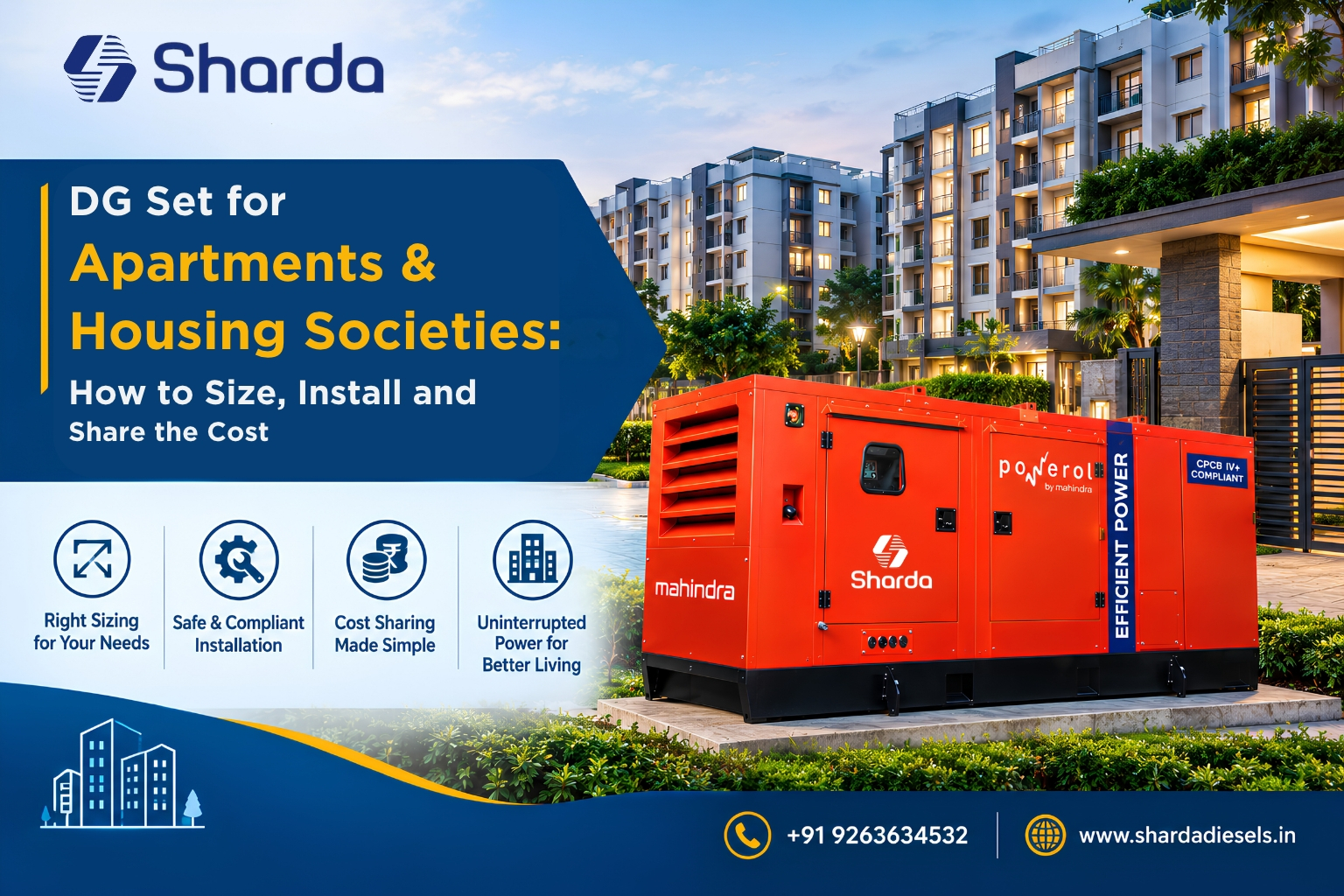
A lift stops with people inside. The overhead tank is empty by evening. That’s usually the day a society committee starts looking into a generator for housing society use, and then the questions pile up. How big should it be? Where does it go? Who pays for it?
This guide answers those three questions in plain words. It’s for RWA committees, builders and property managers in Patna, Ranchi, Raipur and the other growing cities of Bihar, Jharkhand and Chhattisgarh.
First, decide what the generator will run
Agree on the DG backup for apartments, meaning what it covers and what it doesn’t, before anyone talks about kVA. Backing up only the common areas (lifts, water pumps, corridor lights, security) is the cheapest option. Adding a fixed allowance per flat, say 500 W to 1 kW, keeps lights and fans going. Full backup with ACs is the most expensive to run, by a long way.
Most projects size the DG set for an apartment building at about 50 to 60 per cent of the total connected load. Builders, please write the backup per flat into the allotment letter. A vague “full power backup” promise causes more arguments after handover than anything else.
Society generator kVA calculation
Wondering how to calculate DG set capacity for an apartment building? It’s simpler than it sounds. Add the common-area load in kW (if your motors are in HP, multiply by 0.746). Add the flat backup, which is the allowance multiplied by the number of flats. Add 25 per cent for motor starting, because lifts and pumps pull a lot of current for a moment. Then divide by 0.8 and round up to the next standard size.
Take a 60-flat society in Patna with 0.75 kW of backup per flat. Two lifts come to about 11 kW, two pumps about 7.5 kW, and lighting, gate and sewage plant about 10 kW. The flats add 45 kW. That’s 73.5 kW, or about 92 kW with the starting margin. Divided by 0.8, you get roughly 115 kVA, so a 125 kVA DG set is the right pick. These numbers are only an example, so use your own motor ratings.
As a rough guide, 10 to 20 flats usually need around 62.5 kVA, 40 to 60 flats need 125 to 160 kVA, and 100+ flats need 250 kVA or more. Don’t oversize “to be safe”. A set running at 20 per cent load all night wastes fuel.
Installing it properly
- Location: ground level, at least a metre of clear space on every side, and away from bedroom windows.
- Exhaust: the outlet should rise above the building height by 0.2 times the square root of the kVA. That’s about 2.2 metres for 125 kVA. Confirm the exact rule with your State Pollution Control Board.
- Changeover panel: an AMF or ATS panel starts the set on its own when the grid fails. Nobody should have to find the guard at 2 a.m.
- Separate circuits: keep flat AC circuits off the generator feeder, or the set will trip within a week.
- Certificate: any new diesel generator must be CPCB IV+ compliant, so ask for the certificate before you pay.
Noise
A silent DG set for a residential complex keeps noise within 75 dB(A) at one metre. Residential areas have tighter limits, 55 dB(A) by day and 45 dB(A) at night, so placement matters as much as the canopy. Face the set away from the nearest flats and use anti-vibration mounts. An open-frame generator is a bad idea in a residential building.
DG set for housing society price and sharing the cost
A silent 125 kVA set costs roughly ₹10 to ₹13.5 lakh before installation. Over 60 flats, that’s about ₹17,000 to ₹22,500 each. New projects usually build it into the flat price. Existing societies normally use a one-time contribution or the corpus fund, approved at a general body meeting.
For running costs, diesel alone works out to about ₹25 per unit (0.26 litres at ₹95). The fairest method is metered billing for each flat’s use, with common-area diesel split equally.
Here’s an illustrative month. The generator runs 30 hours at 12 litres an hour, which is 360 litres or ₹34,200. Add ₹3,000 for the yearly AMC spread monthly. That’s about ₹37,200 in total, or roughly ₹620 per flat. Residents rarely complain about a number that’s been explained openly.
For builders and developers
Size for full occupancy, not for the first 20 families. Plan the DG space at the design stage. Hand over the CPCB IV+ certificate, warranty papers and an AMC to the RWA at possession, because they’ll be calling you when it fails.
Who to buy from
If you’re looking for a residential complex DG set in Patna, Ranchi or Raipur, buy from a source that will still pick up the phone in year five. Sharda Diesels Pvt Ltd is the authorized OEM manufacturer of Mahindra Powerol DG sets for Jharkhand, Bihar and Chhattisgarh. We supply through authorized dealers in Patna, Ranchi, Raipur, Jamshedpur, Dhanbad, Bokaro, Gaya, Muzaffarpur, Bilaspur and Bhilai. Our single-window 3S service (Sales, Service, Spare Parts) covers load calculation, installation, DG set AMC for societies, genuine spares and technical support, all from one team.
📞 Call: +91 9263634532 🌐 Visit: www.shardadiesels.in
Planning a new generator for your society or project? Share your flat count and location, and we’ll help you pick the right size and connect you with your nearest authorized dealer.
Sharda Diesels Pvt Ltd, Tatisilwai, Ranchi: Authorized OEM Manufacturer of Mahindra Powerol DG Sets for Jharkhand, Bihar & Chhattisgarh. Silent, CPCB IV+ compliant generators for apartments and housing societies through our authorized dealer network. Call +91 9263634532 or visit www.shardadiesels.in.