
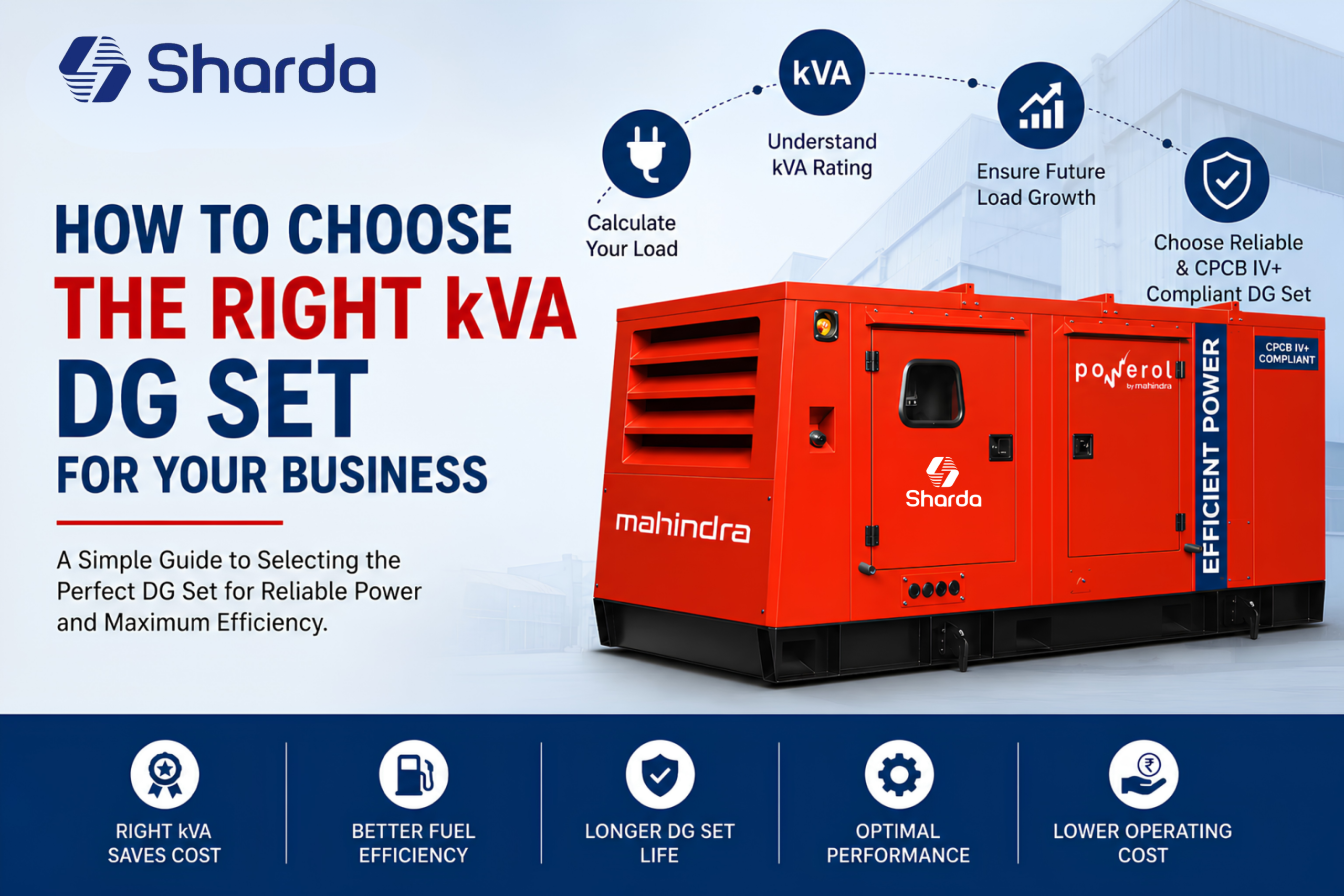
A Complete Guide to Selecting the Best Diesel Generator
Power interruptions can stop production, delay projects, and affect business operations. Whether you run a factory, hospital, hotel, office, warehouse, shopping complex, or construction site, choosing the right Diesel Generator is essential for uninterrupted power supply.
Many businesses make the mistake of selecting a generator based only on price or by choosing a larger capacity than required. An undersized DG Set may overload during operation, while an oversized generator can increase fuel consumption and operating costs.
Sharda Diesels Pvt Ltd, an ISO 9001:2015 certified company and authorized OEM partner of Mahindra Powerol, supplies CPCB IV+ DG Sets from 5 kVA to 625 kVA and customized backup power solutions across Jharkhand, Bihar, and Chhattisgarh.
This guide explains the important factors you should consider before purchasing a kVA DG Set.
What Does kVA Mean?
kVA (Kilovolt-Ampere) is the unit used to measure the apparent power capacity of a generator.
Simply put, the kVA rating indicates how much electrical load a generator can safely handle.
Some popular generator capacities include:
The right generator size depends on your actual power requirement rather than the size of your business.
Understanding kW vs kVA
One of the most common questions buyers ask is:
What is the difference between kW and kVA?
- kVA represents Apparent Power.
- kW represents Actual Useful Power.
The relationship is:
kW = kVA × Power Factor (PF)
Power Factor is dependent on the nature of various equipment connected to the generator. The power characteristics of industrial motors, pumps, compressors and electronic equipment may be differ.
This is the reason that makes professional load calculation necessary in order to select Diesel Generator.
Step 1: Calculate Your Total Connected Load
Prepare a list of all electrical equipment that will operate during a power failure.
This may include:
- Motors
- Pumps
- Air conditioners
- Lighting systems
- Computers
- Compressors
- Industrial machinery
Calculate total running load and allow some headroom for future expansion
An adequately sized generator allows for improved efficiency and less operating cost.
Step 2: Consider Starting Current
Some electrical equipment requires significantly higher power during startup.
Examples include:
- Water pumps
- Air compressors
- Industrial motors
- HVAC systems
A generator should always be selected by considering both:
- Running load
- Starting load
Ignoring starting current can lead to voltage fluctuations and poor generator performance.
Step 3: Decide Between Standby and Prime Power
Not every generator is used in the same way.
Standby Power
Standby generators operate during electricity failures.
Common applications:
- Offices
- Hospitals
- Schools
- Commercial buildings
- Retail stores
Prime Power
Prime power generators are designed for longer operating periods where grid power is unavailable or unreliable.
Common applications:
- Construction projects
- Mining operations
- Remote industrial sites
- Infrastructure projects
Understanding your duty cycle helps in selecting the right generator capacity.
Step 4: Understand Load Factor and Fuel Efficiency
Fuel cost is one of the biggest operating expenses of any DG Set.
A generator operating continuously at very low load may not perform efficiently, while constant operation at maximum capacity can increase wear and maintenance requirements.
Factors affecting fuel efficiency include:
- Load factor
- Runtime hours
- Generator sizing
- Maintenance schedule
Choosing the correct capacity helps reduce long-term operating costs.
Step 5: Consider Site Conditions
Generator performance can be affected by installation conditions.
Important factors include:
- Ambient temperature
- Altitude above sea level
- Ventilation
- Installation space
- Exhaust arrangement
Higher temperatures and higher altitudes may reduce generator output, a factor commonly known as derating.
Proper installation planning helps ensure reliable operation.
Step 6: Check CPCB IV+ Compliance
Environmental regulations are becoming increasingly important.
Modern CPCB IV+ Diesel Generators are designed to reduce emissions and meet applicable regulatory requirements.
A properly designed acoustic enclosure also helps:
- Reduce operational noise
- Improve workplace safety
- Support applicable noise standards
When purchasing a generator, always confirm that the selected model meets applicable compliance requirements.
Why Choose Mahindra Powerol DG Sets?
Businesses across different industries prefer Mahindra Powerol DG Sets because they offer:
- Reliable performance
- Fuel-efficient operation
- CPCB IV+ compliant technology
- Durable construction
- Proven engine reliability
- Strong service support
As an authorized OEM partner of Mahindra Powerol, Sharda Diesels provides dependable power solutions for industrial and commercial applications.
Why Choose Sharda Diesels?
Sharda Diesels Pvt Ltd offers:
- ISO 9001:2015 certified manufacturing
- Authorized OEM partnership with Mahindra Powerol
- DG Sets from 5 kVA to 625 kVA
- Customized power solutions
- Industrial fabrication and acoustic enclosures
- Transparent pricing
- 24/7 technical support
- Service network across Jharkhand, Bihar, and Chhattisgarh
Our team helps businesses choose the right backup power solution based on actual operating requirements.
Quick kVA Selection Guide
| Application | Typical Capacity |
|---|---|
| Small Shop | 10–15 kVA |
| Office | 15–25 kVA |
| Commercial Building | 25–62.5 kVA |
| Small Industry | 62.5–125 kVA |
| Large Industry | 125–625 kVA |
Actual generator sizing should always be based on detailed load calculation.
Common Mistakes to Avoid
Many buyers make these common mistakes:
- Selecting a generator based only on price
- Ignoring starting current
- Not planning for future expansion
- Choosing the wrong duty cycle
- Overlooking fuel efficiency
- Ignoring CPCB IV+ compliance
- Not considering after-sales support
Avoiding these mistakes can save significant operating costs in the future.
Frequently Asked Questions
1. How do I calculate the right DG Set capacity?
Calculate the total connected load, consider starting current, future expansion, and consult a generator expert for proper sizing.
2. What is the difference between kW and kVA?
kVA represents apparent power, while kW represents actual useful power. The relationship depends on the power factor of the connected load.
3. What happens if I buy a smaller generator?
An undersized generator may overload and affect equipment performance.
4. What happens if I buy a larger generator?
An oversized generator may increase fuel consumption and operating costs.
5. What generator range does Sharda Diesels offer?
Sharda Diesels supplies Mahindra Powerol DG Sets from 5 kVA to 625 kVA and customized backup power solutions for industrial and commercial applications.
Conclusion
Selecting the right kVA DG Set is not simply about purchasing a generator. It requires understanding:
- Total connected load
- kW vs kVA
- Starting current
- Standby or prime power requirement
- Fuel efficiency
- Site conditions
- CPCB IV+ compliance
- Future business expansion
A properly selected Diesel Generator improves reliability, reduces operating costs, and supports long-term business growth.
You can also explore our:
- Diesel Generator
- 10 kVA DG Set
- 25 kVA DG Set
- 100 kVA DG Set
- Acoustic Enclosures
pages to learn more about our products and services.
Need Help Choosing the Right Generator?
Sharda Diesels Pvt Ltd provides expert load calculation, generator sizing, and customized backup power solutions across Jharkhand, Bihar, and Chhattisgarh.
 Call/WhatsApp: +91 9263634532
 Email: info@shardadiesels.in
 Website: https://shardadiesels.in/
Contact our team today to find the right Mahindra Powerol DG Set for your business requirements.