
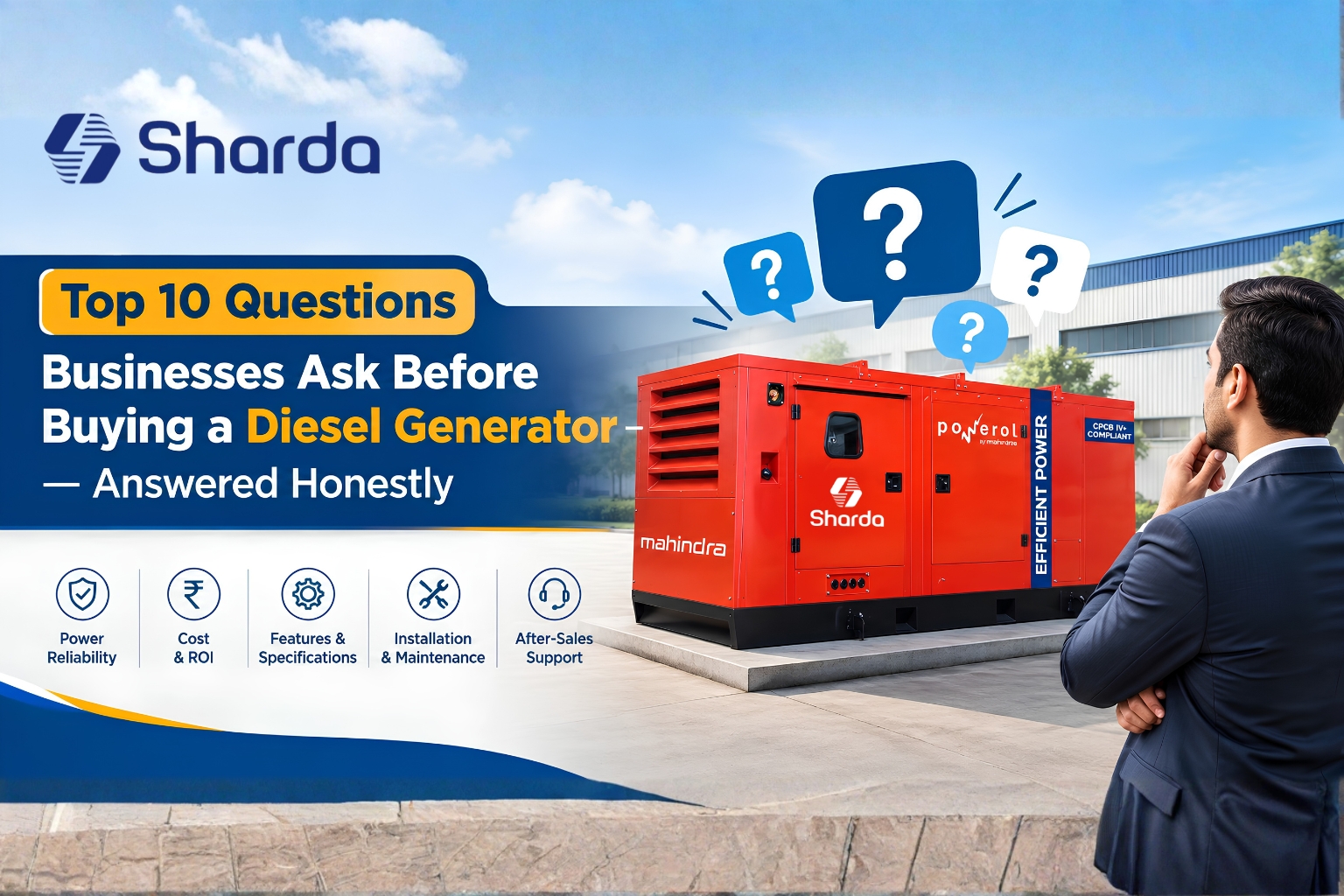
Buying a diesel generator is not like buying a piece of furniture. It is a decision that will affect your business operations every single day for the next 10 to 15 years. And yet, most buyers go into it with very little real information — just a price quote from a local market and some vague advice from a friend who bought one three years ago.
We hear the same questions from business owners, factory managers, contractors, and entrepreneurs across Jharkhand, Bihar, and Chhattisgarh every week. So we decided to answer the 10 most common ones — clearly, honestly, and without any sales pitch.
Q1. How much does a diesel generator actually cost in India?
This is always the first question. And honestly, the frustrating-but-true answer is: it depends.
A 15 kVA silent generator for a small office is a very different product from a 250 kVA industrial genset for a factory. Price ranges in 2026 run from around ₹1.2 lakh for small commercial units all the way to ₹25 lakh or more for large industrial capacity — and everything in between.
What drives the price up?
- Bigger kVA capacity
- Silent/acoustic canopy enclosure (adds 15% to 30% over open frame)
- CPCB IV+ compliance (mandatory now, so factor it in)
- Engine brand and OEM manufacturing quality
The mistake most buyers make is comparing two generators purely on price without checking if they are actually the same product. A ₹3.5 lakh generator from an unauthorized assembler and a ₹4.2 lakh generator from an OEM-backed manufacturer are not the same thing — even if the kVA rating on the spec sheet looks identical.
For accurate pricing on Mahindra Powerol DG sets in your area, the best approach is to contact your nearest authorized dealer directly — they will give you a quote based on your exact requirement.
Q2. What size generator does my business actually need?
More businesses get this wrong than you would expect. Either they buy too small — and the generator struggles, overheats, and breaks down early — or they buy too big and waste money on fuel and capital that is sitting unused.
Here is a simple way to think about it:
Add up all the equipment you need to run simultaneously during a power cut. Not everything in your facility — just the critical stuff. Get that total in kilowatts (kW), add about 20 to 25% on top for motor startup surge, and then convert to kVA (divide kW by 0.8, which is the standard power factor).
That number tells you the minimum kVA rating you need.
If you are not sure how to do this calculation, any authorized dealer worth their salt will help you work it out before you buy. It takes 15 minutes and saves you from a very expensive wrong decision.
Q3. What is CPCB IV+ and why does everyone keep talking about it?
Fair question — there is a lot of noise around this term and not enough plain explanation.
CPCB stands for Central Pollution Control Board. They set emission standards for diesel generators sold in India. CPCB IV+ is the latest and strictest version of these standards — it limits how much particulate matter, carbon monoxide, and hydrocarbons a generator engine can emit.
As of now, CPCB IV+ compliance is mandatory for all new diesel generators sold in India. You cannot legally install a non-compliant new generator.
What does this mean for you as a buyer? Two things. First, always ask for the CPCB IV+ certification document before finalizing any purchase — do not accept verbal assurances. Second, if a seller is offering you a “brand new” generator at a price that seems too good to be true, there is a very real chance it is not compliant — and you are buying a regulatory liability, not a power solution.
Every Mahindra Powerol DG set manufactured by Sharda Diesels Pvt Ltd is fully CPCB IV+ certified across the entire range.
Q4. What is the difference between a silent generator and a normal open-frame generator?
Simple version: a silent generator is the same machine, just enclosed inside a sound-absorbing canopy.
An open-frame generator typically produces 90 to 105 dB of noise. That is roughly as loud as standing near a running lawnmower — continuously. A silent diesel generator with an acoustic canopy brings that down to 65 to 75 dB — about the same level as a normal conversation.
Now here is the regulatory side of this: urban commercial and residential-adjacent zones in India are required to keep generator noise below 75 dB(A). If your business is in a city or near any residential area, a silent generator is not just a comfort choice — it is a legal requirement.
Silent generators cost a bit more upfront. But the noise reduction, compliance protection, and the simple fact that your customers, staff, and neighbours are not subjected to engine noise all day long makes it worth every rupee.
Q5. How much diesel does a generator consume per hour?
This is the question that determines your real running cost — and most buyers do not ask it specifically enough.
Here is a rough guide based on 75% load (the standard industry benchmark):
- 25 kVA generator — approximately 3.5 to 5 litres per hour
- 62.5 kVA generator — approximately 8 to 12 litres per hour
- 125 kVA generator — approximately 15 to 18 litres per hour
- 250 kVA generator — approximately 28 to 35 litres per hour
At current diesel prices of approximately ₹92 to ₹98 per litre, a 62.5 kVA generator running 6 hours a day costs roughly ₹5,000 to ₹7,000 per day in fuel alone. Over a year, that is a significant amount — which is exactly why fuel efficiency is not just a technical spec, it is a financial decision.
A well-engineered, fuel-efficient engine like Mahindra Powerol’s can save you meaningful money over years of operation compared to a cheaper but inefficient alternative.
Q6. How long does a diesel generator actually last?
A properly maintained diesel generator from a quality OEM manufacturer can reliably last 15 to 20 years — or between 20,000 and 25,000 operating hours.
But here is the catch: that lifespan assumes proper, scheduled maintenance. A generator that is run hard and serviced inconsistently will start giving serious trouble within 5 to 7 years. We have seen businesses replace generators in under 5 years because of poor maintenance — and then blame the brand, when the real issue was how the machine was treated.
This is why your buying decision should not end at purchase. The service and maintenance plan you put in place from day one directly determines how many years you actually get out of your investment.
Q7. What kind of maintenance does a diesel generator need?
Think of it like a car. You would not drive a car for years without an oil change and expect it to keep running perfectly. A diesel generator is the same.
Regular maintenance for a commercial DG set typically includes:
- Engine oil change every 250 hours of operation or every 3 months — whichever comes first
- Air filter cleaning or replacement every 500 hours
- Fuel filter replacement every 500 to 750 hours
- Coolant check and top-up every service visit
- Battery check and terminals cleaning monthly
- Load bank testing annually — to ensure the engine can handle full load
- Belt and alternator inspection every 1,000 hours
The good news is you do not need to track all of this yourself. That is exactly what an AMC is for — which brings us to the next question.
Q8. What is an AMC and do I really need one?
AMC stands for Annual Maintenance Contract. It is essentially a planned servicing agreement between you and your generator supplier — where scheduled maintenance, oil changes, filter replacements, inspections, and minor repairs are handled on a fixed schedule without you having to follow up or manage it.
Do you need one? Look at it this way.
If your generator breaks down mid-production, mid-harvest season, or during a busy event — the cost of emergency repairs, downtime, lost production, and spoiled goods will almost certainly exceed what an entire year of AMC would have cost you. And an AMC-maintained generator rarely breaks down unexpectedly, because problems are caught during scheduled visits before they become failures.
For most businesses — especially rice mills, cold storage units, factories, hospitals, and hotels — an AMC is not an optional expense. It is what protects a multi-lakh investment and keeps it running reliably for 15 years instead of 6.
Q9. What happens if I buy a generator from an unauthorized seller?
This comes up more than it should. And the honest answer is — it might work fine for the first year. After that, things tend to get complicated.
Here is what typically goes wrong with unauthorized or grey-market generator purchases:
Warranty is worthless. The warranty document looks real, but when you go to claim it, you find out it is not backed by the actual manufacturer.
Spare parts are a problem. Non-standard or counterfeit parts are used in grey-market assemblies. When something breaks and you need a replacement, the part either does not exist or costs you far more than it should.
CPCB IV+ may not be genuine. Non-compliant generators are still being sold with fake certification documents in some markets. This exposes your business to regulatory action.
No accountability. When a problem comes up and you call the seller, they are unavailable, unhelpful, or have simply shut up shop.
Buying through an authorized OEM manufacturer and dealer network — like Sharda Diesels Pvt Ltd’s network across Jharkhand, Bihar, and Chhattisgarh — means genuine products, real warranty coverage, genuine spare parts, and someone accountable when you actually need help.
Q10. My budget is tight. Should I just buy a cheaper local generator?
We understand the budget pressure — especially for small and mid-sized businesses. But here is something worth sitting with before you decide.
A cheap generator that breaks down 3 times a year costs you repair bills plus downtime. A cheap generator that fails during your peak season costs you production losses, customer penalties, and sometimes spoiled inventory. A cheap generator with a fake CPCB IV+ certificate costs you regulatory risk. And when it finally gives up entirely after 5 or 6 years, you are buying again from scratch.
The total cost of a cheap generator over 6 years — including repairs, fuel wastage from poor efficiency, downtime losses, and an early replacement — almost always exceeds the cost of buying the right generator once and maintaining it properly.
That said, buying the right generator does not have to break the budget either. The right approach is to size accurately (not oversize), buy CPCB IV+ compliant from an OEM-backed source, and set up an AMC from day one. Your nearest authorized Mahindra Powerol dealer can work with you on this.
Still Have Questions? We Are Happy to Help.
These are the questions we hear most often — but every business has its own specific situation, load requirements, and budget. If you have something more specific in mind, just reach out. Our team will give you straight answers — no pressure, no overselling.
 Call Sharda Diesels: +91 9263634532
  Visit: www.shardadiesels.in
Sharda Diesels Pvt Ltd, Tatisilwai, Ranchi — Authorized OEM Manufacturer of Mahindra Powerol DG Sets for Jharkhand, Bihar & Chhattisgarh. CPCB IV+ compliant diesel generators available through our authorized dealer network across Ranchi, Jamshedpur, Dhanbad, Bokaro, Patna, Gaya, Muzaffarpur, Raipur, Bilaspur, Bhilai, and more. Call +91 9263634532 or visit www.shardadiesels.in to find your nearest dealer.